Not only an asset but Google's "loyalty." Online marketer's view on business acquisition.
Data from 6,271 websites shows how long it takes to build Google authority, and why older domains command premium prices.
In April 2024, we examined the performance of 6,271 websites from the Flippa database to find out how long it takes to gain traffic from Google and build an authoritative website both clients and search engines will like.
Continue reading to learn:
- A new website usually takes three years to gain momentum in traffic growth.
- It takes almost two years to appear in Google’s TOP-10 results.
- Websites ranked beyond TOP-10 are getting less than 1% of the search traffic.
- Primary ranking factors are the critical mass of high-quality content and backlinks from reputable websites.
- Cheap shortcuts like mass content production using AI may result in a ban from Google.
- Buying an existing website with immediate access to traffic and revenue is a great way to save time and mitigate risks.
Backstory – Most Startups Fail
70% of startups fail within the first five years.
Over the long run, the failure rate is 90%. Only 1 in 10 startups make it.
This widely-known yet sad statistic is why people often prefer buying existing businesses over starting new ones. They are purchasing a winner of this game.
Usually, launching a company costs less than buying an operating business.
But numbers are playing against the founder.
Only 18% of first-time startup founders succeed. 82% chance of losing money in a startup is an excellent reason to consider acquiring a well-established business.
I’ve launched several startups in my life; most of them failed, but few survived long enough to bring profits and be sold.
I also acquired a few businesses and websites during my professional career, from a small acquisition for my needs to a multi-million deal tailored for a publicly traded company.
So, I’ve been on both sides.
Long story short – buying a business saves years and effort in developing a working business model, hiring a reliable team, finding suppliers and providers, managing cash flow, building the marketing engine, etc.
If anything mentioned fails, the whole business is at risk. There’s a stat of reasons for failure:
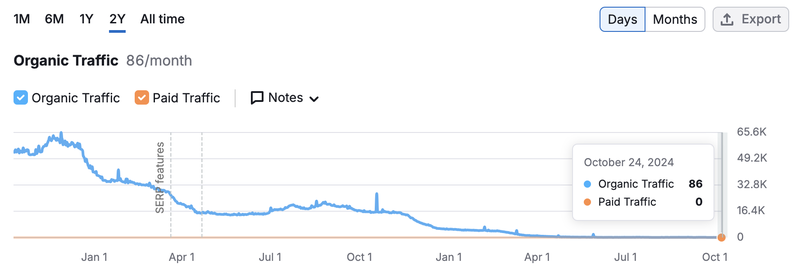 Image and research credit – Exploding Topics.
New businesses face a lot of uncertainty. Existing companies have already figured it out.
The investors’ community is widely aware of these facts. It’s nothing new.
But there’s another major factor for the Internet-based businesses.
Google’s “bias” toward older websites is real.
The proof will follow in a minute. Let me remind you of the basics of the SEO concept.
SEO is a marathon.
Most buyers search online for a new product or service. Different sources state that the number is between 81% and 95%.
That’s a solid share.
So, getting visibility in search engines is vital for most internet businesses.
The only ways to gain visibility on search engines are through ads or organic rankings.
Paid ads are “sprints” – you pay Google and immediately get traffic, guaranteed. Any business can do it at any stage.
But it comes with a price tag – every visitor costs you. You stop paying, Google doesn’t send the traffic. And every visitor may cost more than the business will earn from them.
Organic rankings work differently. Great content on your website attracts free “organic” visitors from Google that convert into customers for the business. You can stop producing the content, and traffic will continue for years. (You can check website organic traffic here.)
SEO game played right has no competitors driving revenue at the lowest possible customer acquisition cost.
The opposite is also true. It’s hard to build a sustainable business online without succeeding in SEO.
The thing is – SEO is a marathon. It takes years, doesn’t guarantee results, has risks, and can even damage the business if done incorrectly. Finding a reliable SEO pro or a team to work with also takes time.
Long-existing online businesses with established performance have already gone through this.
And it’s probably the most overseen yet underestimated reason to buy an existing website-based business.
Buyers know how the website is performing. Builders can assume and hope. It takes years to figure it out.
Now, let’s turn to the firm data to learn how long it takes.
How long does it take to get traffic?
According to Google’s Maile Ohye, it can take a new website up to 12 months to get even the first trickle of traffic from search results.
Based on our recent research, it takes 3+ years for a new business website to gain momentum in growth.
Here is a graph for the average monthly organic traffic based on data from 6,271 online business websites listed on the Flippa marketplace over the last few years:
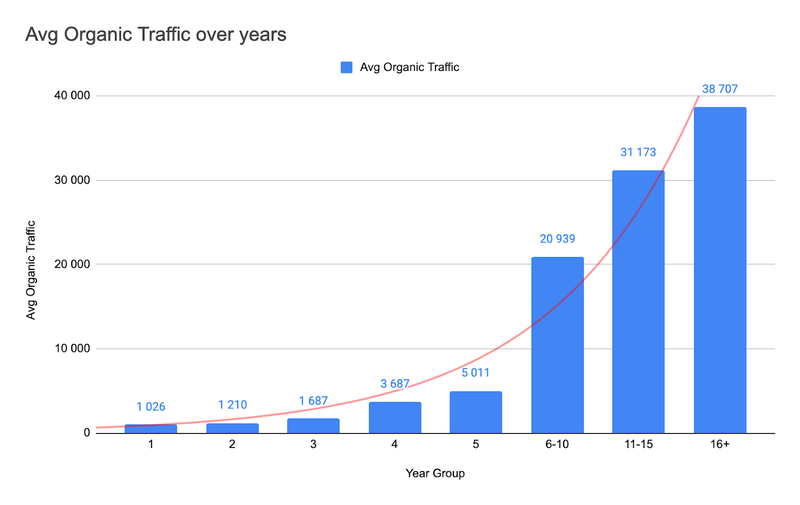
As you can see, on average, organic traffic has been almost flat during the first three years. It takes off in year four and grows faster past the five-year mark.
It is worth mentioning that 95%+ of websites don’t get any traffic. One thousand visitors per month in the first year is not usual for the Internet. Our number is that high because the sample of our research was built on operational online businesses from the Flippa marketplace. So, this data is valid for benchmarking online businesses rather than average websites.
Let’s dive into the reasons behind the slow increase in organic traffic for a new website.
Getting into TOP-10
The main reason is simple – search engines aim to maintain a high quality of search results while mitigating manipulations and spam.
New websites are just way more risky than those with long-established reputations. So, Google is playing safe by suggesting content from better-known sources.
The two main reasons behind the poor performance of new websites are low trust from the search engines and the lack of content.
As a result, Google prioritizes older websites when showing the top-10 search results.
You may ask why being in the top 10 is critical.
Because 99.4% of Google searchers never click results beyond the first page. Internet marketers even joke that hiding a dead body on the second page of the search results is easy. Nobody will seek it there. The firm data back this joke!
Only 0.63% of Google searchers clicked on something from the second page.
So, how long does it take to be ranked in the top 10?
2024 research of Google ranking factors from Semrush found that the average age of a website in the Top-10 results is 20 (sic!) years old. This number is, of course, overweighted due to the dominance of Amazon, Reddit, Forbes, and other content mammoths in search results. But still, it’s indicative.
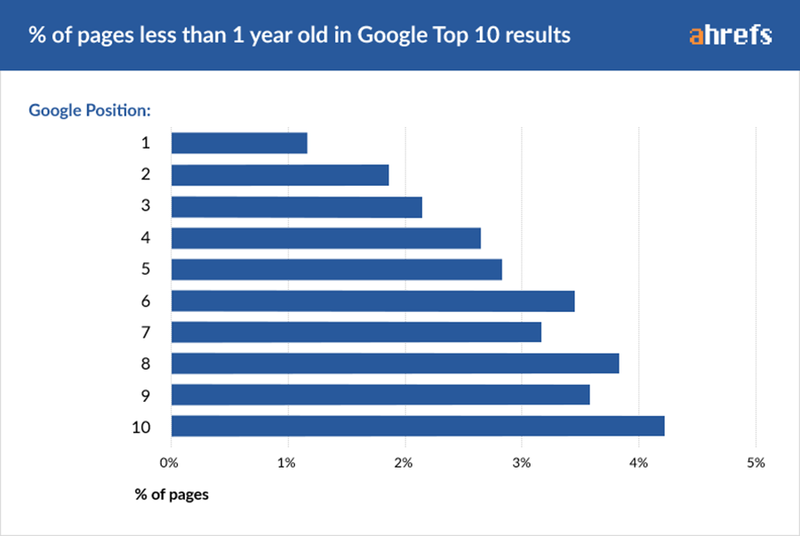
Similar research from Ahrefs focused on the pages’ age, showing an average of almost two years to appear at position ten and nearly three years to win the first rank:
Of course, it’s still possible for a new website to rank on top of search results. But statistically, chances are low.
Sad for startups, yet true. There’s a lot of data and explanations supporting this fact.
Gaining the Google’s trust.
As we see, the content posted on a new website will rarely rank high on Google. The same content published on an established, authoritative website will often rank immediately in top-3 results without any extra effort.
All because this website has more “trust” in Google’s eyes.
How do you gain the “trust” then?
The only way to gain this trust and establish “authority” is by accumulating helpful, high-quality content over time and growing the number of other websites referring to this content.
As mentioned above, the number of referring websites is a major Google ranking factor. Unsurprisingly, there’s a strong correlation between the number of other websites referring to the site and organic traffic.
Getting back to our research of 6k+ websites, this is how long it takes to accumulate the referring domains for a median website:
 Data credits: Flippa
You can see that the trend looks very similar to the traffic growth pattern. The number of referring domains is usually close to zero during the first two years after the business launch. Growth accelerates in year three and beyond.
The same acceleration can be noticed in the number of ranking keywords.
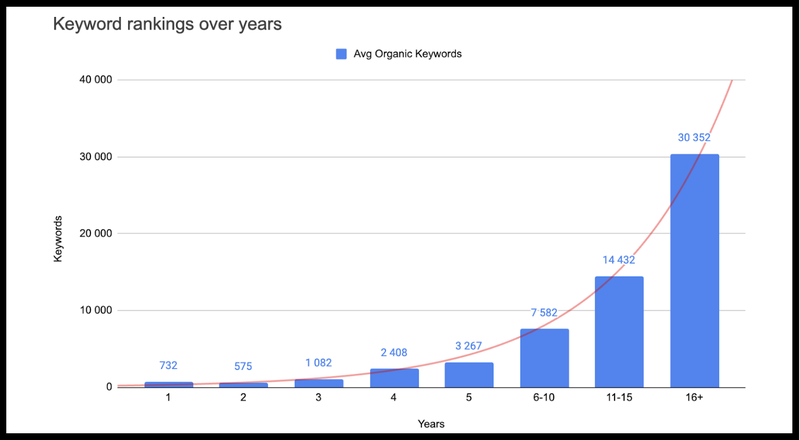
As the site ages and gains more “authority” in Google’s eyes, it starts to rank for more and more keywords.
Measuring the trust and predicting the performance.
To easily compare websites and predict their performance in Google searches, various SEO tools have created so-called “authority” scores. For example, the Semrush Authority Score evaluates the website’s content performance on Google, factoring in the referring domains, the number of backlinks, and their quality.
Again, it should be no surprise it takes years for a site to build its authority score. Our research found a clear correlation between the website’s age and the Semrush Authority Score.
 Data credits: Flippa
The takeaway so far is that SEO takes years. Authority takes years. Organic traffic takes years. And unfortunately, there are no safe shortcuts.
Shortcuts are precisely the most dangerous part of SEO. Let’s spend a minute on them before wrapping up.
AI boom and bust
Up until March 2024, the Internet was full of “success stories” from websites that published thousands of AI-generated content and skyrocketed from zero to thousands or even millions of visitors per month in less than a year timeframe.
Some even packed their “success” into content-creation software and sold this “solution” to other businesses.
After noticing the rise of low-quality content, Google took action in March 2024 by rolling out its “Useful Content Update.” They entirely excluded at least 74,000 websites from the search results. Meaning their traffic dropped to zero.
Let me show you a real example of such a website:
Graph from Semrush Domain Overview tool showing monthly organic traffic for zacjohnson.com
Bottomline
Based on various research from different vendors and our analysis of the Flippa database, it takes 3+ years on average to develop a website that will perform well on Google. This results from Google’s “bias” toward older websites with established reputations and a more extended history of high-quality content. Acquiring an existing online business helps to overcome the usual business risks plus saves years and effort in getting Google’s trust.

Max Roslyakov
Founder, Xamsor