How We Onboard SEO Clients (Our 7-Step Process)
In the last six months, we onboarded six clients for SEO consulting and link building.
Based on the results we achieved (and the snags we hit), we created an SOP (Standard Operating Procedure) for new client onboarding. The goal is to get to real work quickly, avoid weeks of back-and-forth, and build a foundation that allows us to execute autonomously.
This article is the SOP. If you’re a marketer, feel free to steal it.
Step #1: Setting Expectations
Before any SEO work starts, we send a structured email to the client outlining how we work.
We frame this engagement as a specific 3-Month Experiment. A trial period of sorts with defined outcomes. This aligns expectations with the new client.
With that expectation in place, we cover a few things in our welcome email:
First, the final goal.
This can be to drive traffic, generate clicks, or receive inbound requests. We use concrete keywords to target.
Then, set realistic expectations that can be achieved within the timeframe.
Second, define the outcomes.
Once the goal is finalized, we define outcomes for the next three months: What's a good result, what's acceptable, and what's a failure. Each is clearly defined with metrics.
Defining the metrics for each scenario, including failure, gives transparency and builds trust with the client.
Third, reporting.
We send monthly reports. The reporting includes critical technical errors addressed, backlinks and mentions created, changes in keyword rankings, and next month’s SEO recommendations and ideas.
That’s the gist. Of course, we customize it slightly for each client. But the core stays the same.
Step #2: Get Technical Access
Next, we ask the new client for three things:
- Access to Google Analytics (GA4)
- Access to Google Search Console
- Company details for invoices.
Because it’s a business, after all. 🙂
Step #3: Set Up Rank Tracking
Now that we have the target keywords to focus on, we set up rank tracking in our own tool, FatGrid.
Why build our own tool?
Popular tools like Semrush and Ahrefs, we noticed, have been less reliable of late and sometimes hallucinate results. So we ended up building this tool for rank tracking.
To set up tracking, go to Google Search Scanner within FatGrid. And click the “New Search” tab.
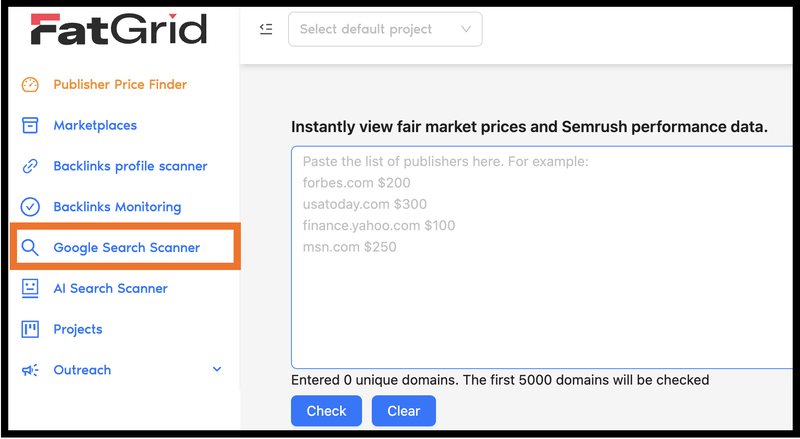
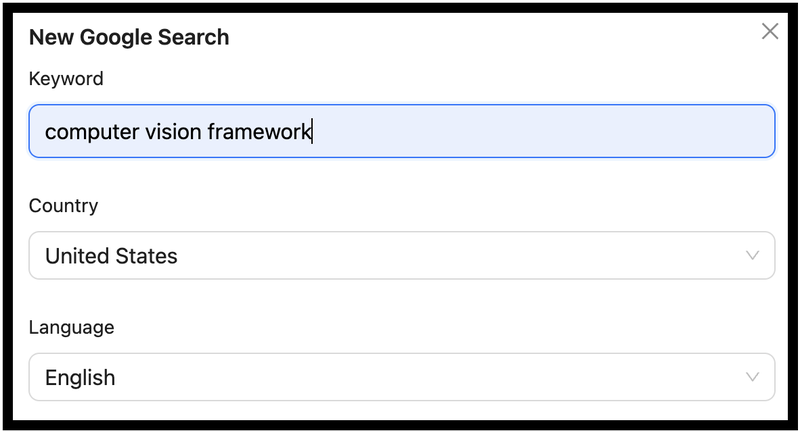
Search for your target keyword. For example, I’m searching for “Computer Vision Framework.” You can also customize for country and language within the search.
Once you hit search, you’ll get the SERP results. A list of websites ranking for the target keyword.
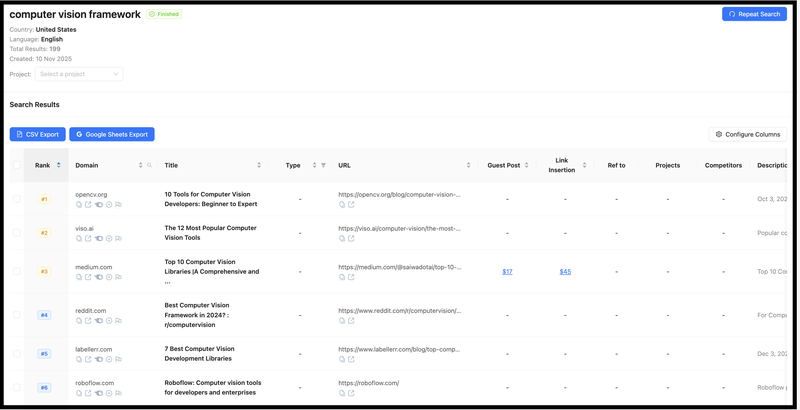
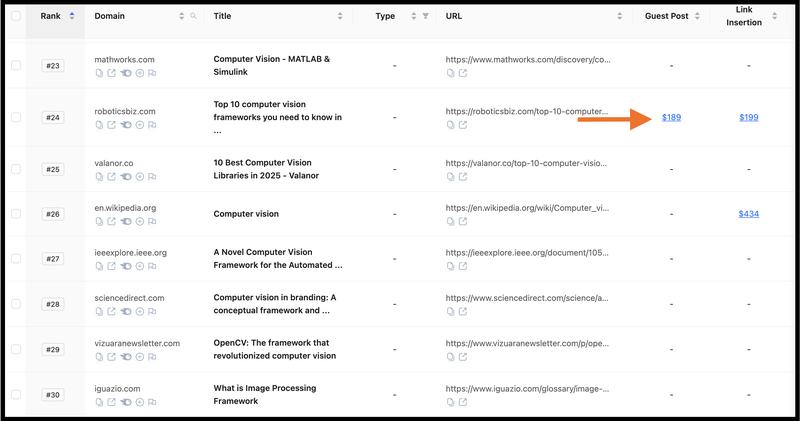
(You can also see the guest post and link insertion prices for the sites ranked, which speeds up link building later. More on that in Step #7.)
For now, we stick to the rank tracking.
Once searched, each target keyword and its rankings are saved. You can revisit them easily again to track how rankings shift.
If interested, you can check out FatGrid’s Google Search Scanner here, and this feature’s user guide here.
Step #4: Technical Audit
Next, we run a site audit using Semrush.
The goal isn’t to rebuild the website. But to understand if we have any critical problems to address. Is the site’s technical health good, and are there any critical errors that need immediate attention?
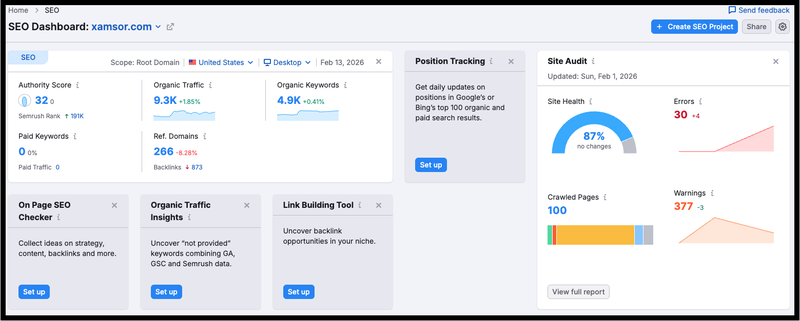
Our technical SEO specialist reviews the Semrush Site Audit results and the current site structure against best practices and creates tasks for technical improvements, such as redirects or small keyword adjustments.
It’s usually a bad idea to start with big structural changes. It is much better to focus on content, backlinks, and basic technical health first.
For technical health, the free versions of Semrush or Ahrefs are often enough to identify the most critical issues.
Step #5: The Founder Interview
This is the most important step in the client onboarding. We interview the company founder for about an hour, covering roughly 20 questions.
These interview questions are based on my business experience. And they’re actually not necessarily about SEO. But they help a lot with our SEO and future link placements.
This is the secret “sauce” in our entire onboarding process.
Why? Because it helps us:
- To understand the final goal better.
- To understand the target audience and target keywords.
- Most of all, it helps us in guest post outreach and link insertions. We will come to this shortly.
Here are the questions we use:
- How and when was your company created?
- Founder’s background and expertise highlights
- What is the essence of your business?
- What problem do you help customers solve?
- What are the alternatives (actions) customers usually consider?
- How do you make money, and who pays?
- Who is the typical customer (ICP - primary, secondary)?
- How do customers typically find you (channels)?
- What is your typical deal timeline?
- Who are your competitors that solve the problem similarly (companies)?
- Who are your competitors in search? Who rocks content and search results?
- How are you better than competitors, and why do customers prefer you?
- What is the most misunderstood part of your product or category?
- What are development plans?
- What typical issues appear when working with customers?
- How do customers usually try to solve these issues on their own?
- How do you help prevent these issues during onboarding and delivery?
- Any ratings or recent numbers to share?
- Free talk
A key thing to note here is: it's not an SEO questionnaire. There's nothing about technical audits, SEO fixes, meta tags, or content calendars. It's a business questionnaire!
Step #6: Finding the Gap
After the interview, we take the call transcript, feed it into Claude, and ask it to crawl the first 10 pages of the client's website.
Then we compare what the founder said with what the website actually communicates.
There’s almost always a gap, no matter how good or old the site is. Founders' ideas and vision move faster than their websites can keep up with.
So, this gives us content ideas and the next set of tasks to work on. Specifically, content on topics the founder clearly knows but the site doesn’t cover.
Step #7: Building Backlinks
The founder interview also improves our link outreach.
For example, ranking websites for the target keyword above (“Computer Vision Framework”) would require numerous manual outreach emails for link placements. Most of them are generic, AI-generated, or templated.
But when we reach out to a website owner asking them to mention our client in their article, we are more specific, more relevant, and more contextual. We write like industry professionals, using the founder's industry-specific terms and jargon from our interview.
As a result, our response rate is really high for this market. All because of the onboarding interview.
For sites that are already listed in link building and guest-posting marketplaces, FatGrid also provides an easy way to build links.
You can see the link prices in the Guest Post and Link Insertion columns.
Final Thoughts
The goal of client onboarding is to get the data at once and not bother the client with back-and-forth communication. The pointless drip emails and constantly asking for clarifications are ineffective both for us and the clients.
With this SOP, we get everything right away, so we can work autonomously. And focus on delivering results to our clients. That’s the goal of good onboarding.
Get the data. Understand the business from the founder's perspective. Then execute and let results do the talking.
Note: This article may contain affiliate links. Please read our full disclaimer.
Have something to say? Join the discussion on LinkedIn or subscribe to stay tuned.

Max Roslyakov
Founder, Xamsor