Profound Review (2026): Smart Diagnosis, Enterprise-Only Fix
Profound's own AI admitted it wrote my trial prompts without demand data. The fix needs an Enterprise plan. My hands-on test, real prices and verdict.
Profound raised $180M in September 2026, at a $1.8B valuation. It says a third of the Fortune 100 trust it.
I run a small B2B company, so I wanted to see how it treats a brand like mine. I started the free trial with FatGrid and recorded the whole session: almost 42 minutes.
The most honest line of the test came from Profound itself. Its AI admitted it wrote my 50 tracked prompts "from the business summary alone", without any data on how my buyers search. Fixing them needs an Enterprise plan.
Below: how Profound did on my six questions, its real prices, the four sign-ups it took to get in, and who should pay for it.
What is Profound?
Profound is an AI visibility platform. It tracks how often ChatGPT, Gemini, Google AI Overviews and other AI assistants mention your brand, compares you with your competitors, and shows which websites those answers cite. A chat assistant called AI Marketer turns the data into suggestions. Profound started in New York in 2024.
Its public pitch aims at big brands: the pricing page shows only a free trial and a custom Enterprise deal. (For the bigger picture, see who is winning the AI race.)
Key facts about Profound
Company: Cooper Square Technologies Inc., New York. James Cadwallader and Dylan Babbs founded it in 2024.
Funding: a $180M Series D at a $1.8B valuation in September 2026, led by Sequoia and Kleiner Perkins. It came less than seven months after a $96M Series C.
AI models: the trial tracks ChatGPT, Gemini and Google AI Overviews. Enterprise tracks up to 9, adding Perplexity, Google AI Mode, Copilot, DeepSeek, Claude and Exa.
Tracking: daily.
Price: the public pricing page shows a free trial and a custom Enterprise plan. Inside the app, brand plans start at $99 a month. Agencies pay $99 a month plus $399 a month per client.
Trial: 7 days and 50 prompts, with a work email only.
My 6 questions for any AI visibility tool
Every tool in this series gets the same six questions:
Am I visible for my queries?
Who are my competitors in AI answers? Does the tool find the right ones?
How am I doing versus those competitors?
How do I improve, and is the advice something I can act on?
Am I progressing over time?
How are my competitors progressing, and who is winning?
For the test, I signed up as a brand with my FatGrid work email. FatGrid compares guest post and backlink prices across marketplaces, so it's a niche B2B tool. (Here's my FatGrid review if you want the details.)
I kept Profound's default setup. It wrote 50 prompts and ran them every day on ChatGPT, Gemini and Google AI Overviews.
Note: FatGrid is my company. So is LinkDetective, one of the rivals Profound named. I used Profound's free trial and paid nothing.
One more thing. My Peec AI review used improvado.io, a much bigger brand. Profound's trial only analyzes the domain of your sign-up email, so the test brand had to be FatGrid. A niche brand gives any tracker less to work with, and I keep that in mind below.
How Profound answers each question
1. Am I visible? No, because the prompts describe a different business
Day one showed "No data found" on every visibility chart.
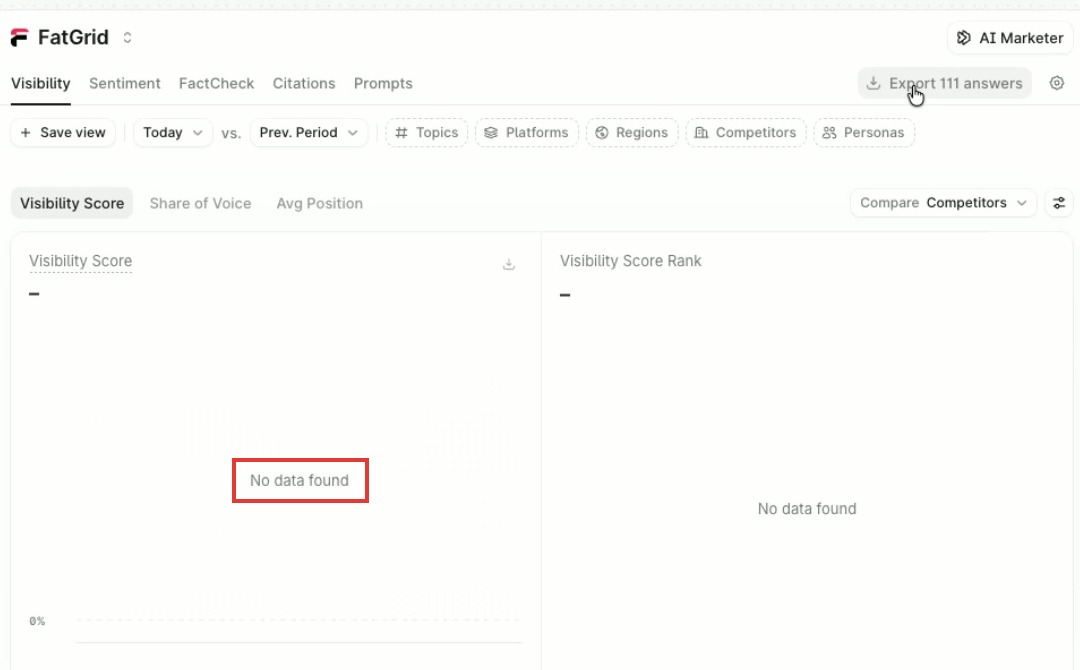
That's normal for a first day. But Profound already let me export 111 raw answers, so I read them.
The first prompt I opened was "What SEO writing tools have the best reviews from freelance writers?" It has nothing in common with my business.
Here's why. Profound filed FatGrid under "SEO Software", with topics like keyword research, rank tracking and content optimization. FatGrid sells price data on guest posts and backlinks.
A few prompts did fit, like link building and backlink analysis. Those answers reflected the real market.
The only visibility number I found sat inside an AI Marketer suggestion: FatGrid at 1.7% on link building prompts. Four rivals scored between 30% and 76.7%.
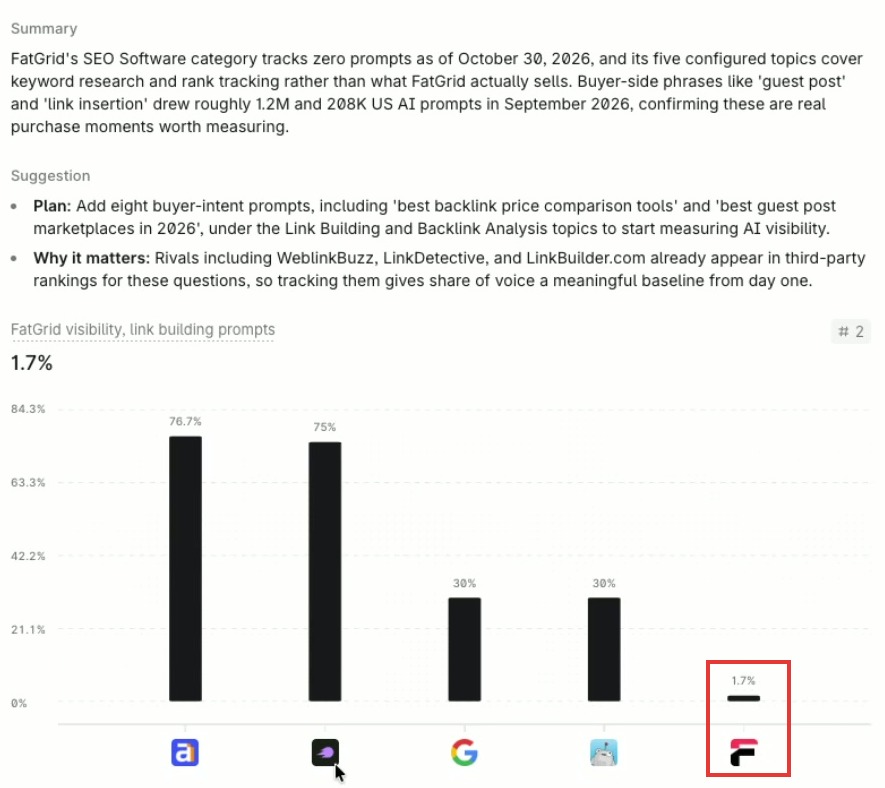
I tried to fix the prompts. Editing them is locked on the trial, and Profound's idea of my business looked locked too.
Bottom line: Profound measured my visibility for the wrong business.
2. Who are my competitors? Semrush and Ahrefs, says Profound
Onboarding skipped competitors entirely. Profound took whatever brands the AI answers named.
So I asked AI Marketer directly: "Who are my competitors in AI responses?" It put FatGrid in the same tier as Semrush and Ahrefs. Its later summary listed Semrush at 70%, Ahrefs at 64%, Google at 45% and SE Ranking at 34%.
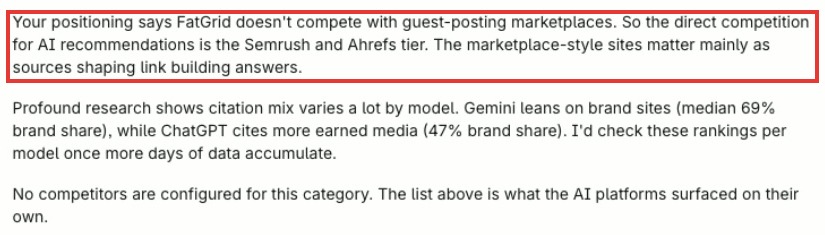
It's a big honor. It's also wrong. FatGrid's real rivals are tools for buying links, like LinkDetective and LinkBuilder.com.
Those rivals did appear once, inside an AI Marketer suggestion. The list itself was read-only for me.
Pro tip: if you test Profound, ask AI Marketer "Who are my competitors in AI responses?" on day one. It's the fastest way to see if Profound understood your market.
Bottom line: your competitor list is whatever the AI engines say.
3. How am I doing versus competitors? Only against the wrong ones
Profound does compare brands. But its top 10 by visibility were all general SEO suites, and FatGrid sat outside that list.
Citation share told the same story: FatGrid at 0%. Reddit, Zapier, NoBS Marketplace, Google and YouTube led the cited sources.
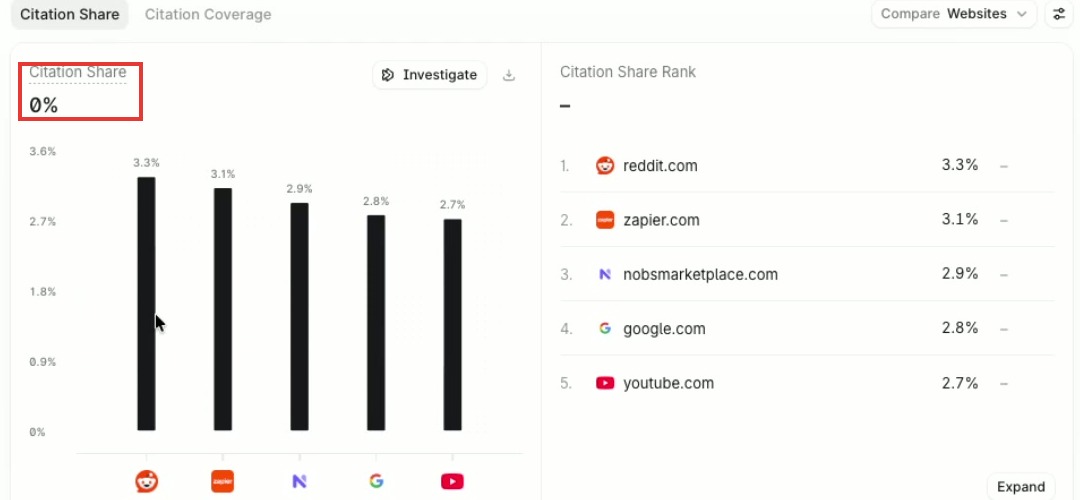
Bottom line: Profound compared me with the wrong rivals.
4. How do I improve? Legit advice, but basic
Most of AI Marketer's suggestions were indexing work, like rendering FatGrid's publisher table on the server. That helps with Google and AI search alike. It's general SEO hygiene.
Two suggestions were specific to my business. Both were real.
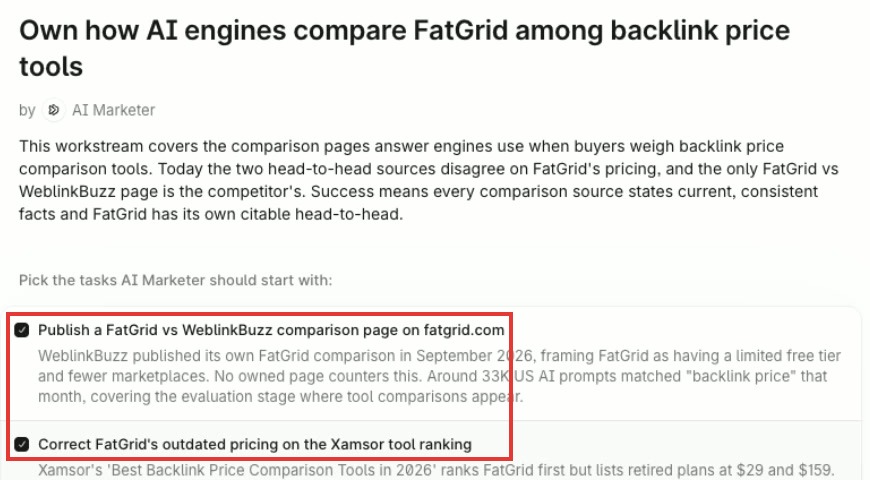
First, Profound found outdated FatGrid prices in our own ranking of backlink price comparison tools. It was right: the page still listed old plans. I fixed it the same day.
Second, it said the only FatGrid vs WebLinkBuzz page belongs to WebLinkBuzz, a much smaller tool. That's true too. A small site that owns the only head-to-head page can shape what AI assistants say about you.
Then I asked what to do overall. AI Marketer's plan had three steps: replace the prompts, publish pages with my own data, and refresh them often. Its reason for the last one: the median page loses half its citation share within 11 days.
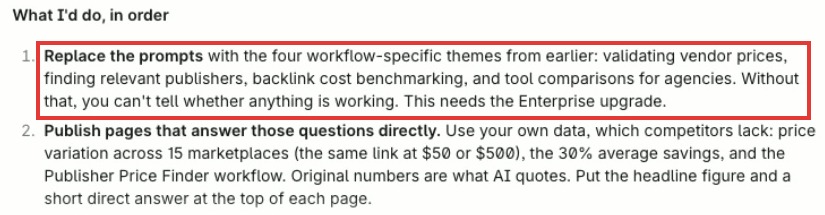
Here's the catch:
Step one needs the Enterprise upgrade.
Bottom line: the advice is legit yet basic, and it barely touches my real market.
The twist: Profound's AI found its own mistake
This is the part that surprised me.
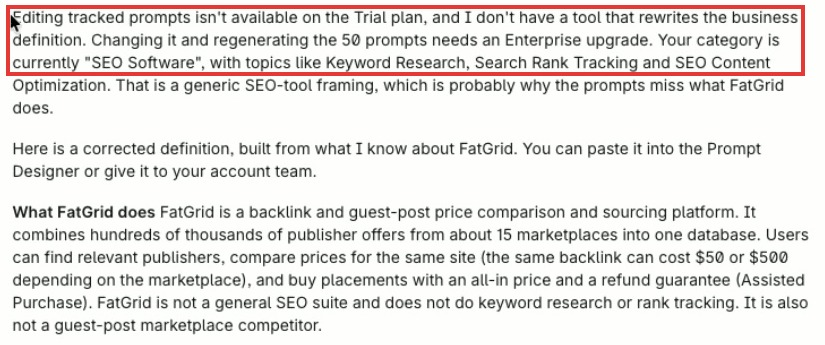
I asked AI Marketer to rewrite its definition of my business. Its new version was right. FatGrid compares guest post prices across about 15 marketplaces, and its clients are SEO agencies and link builders.
It also told me where the old one came from: the category "SEO Software". Changing that category and rewriting the 50 prompts needs an Enterprise upgrade.
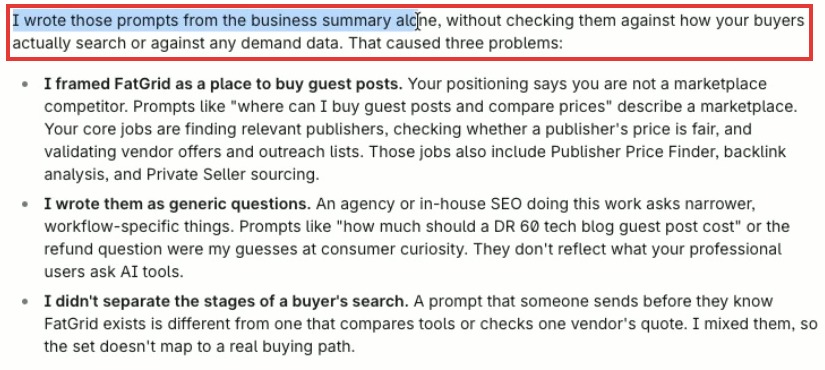
So I asked why the prompts missed. Its answer:
"I wrote those prompts from the business summary alone, without checking them against how your buyers actually search or against any demand data."
Now:
Profound sells demand data. Its Prompt Volumes feature runs on "1.5 billion+ real AI conversations". Its own assistant skipped that data when it set up my account.
Bottom line: the diagnosis is right. The fix sits behind Enterprise.
5 and 6. Am I progressing, and who is winning? Too early to say
I had one partial day of data. The trial tracks every day for 7 days, so a week could show a trend.
It would show a trend on prompts that describe the wrong business, though.
Profound pricing: real prices only inside the app
Profound's pricing page lists two plans: a free trial and a custom Enterprise plan. Nothing in between.
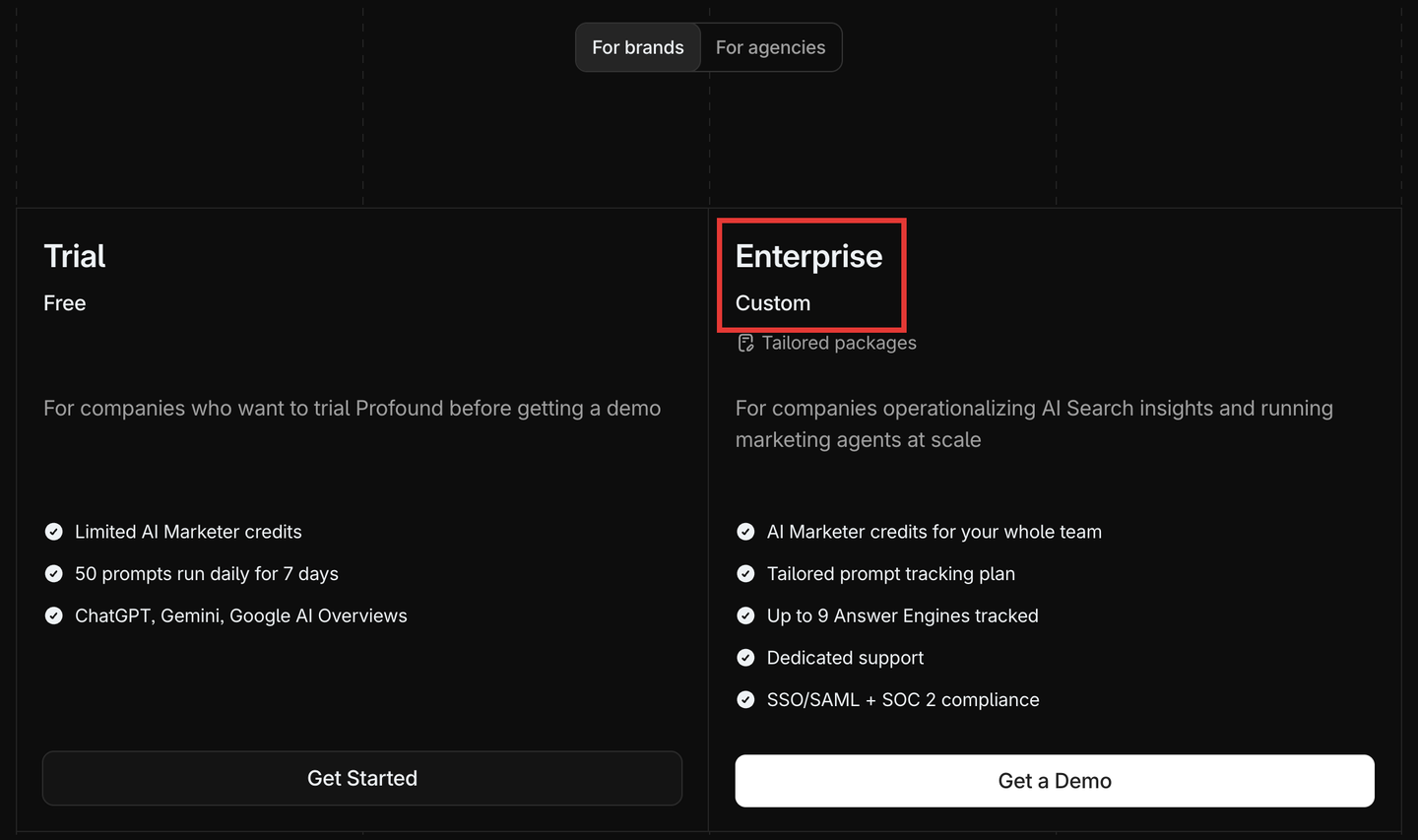
As a founder, I skip vendors who hide their prices. A hidden price usually means enterprise software, with an enterprise bill and an enterprise sales process.
To be fair, the trial is enough for a first look. ChatGPT sends most AI traffic, and the trial tracks it for 7 days.
Inside the app, real prices do exist:
Starter: $99 a month, 50 prompts, ChatGPT only, 1 seat
Growth: $399 a month, 100 prompts, ChatGPT, Perplexity and Google AI Overviews, 3 seats, 7 days free
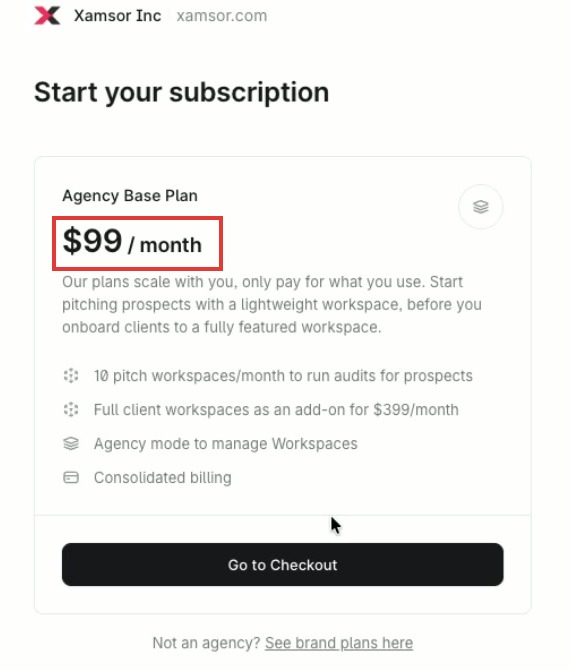
Agency Base: $99 a month with 10 pitch workspaces a month, plus $399 a month for each full client workspace
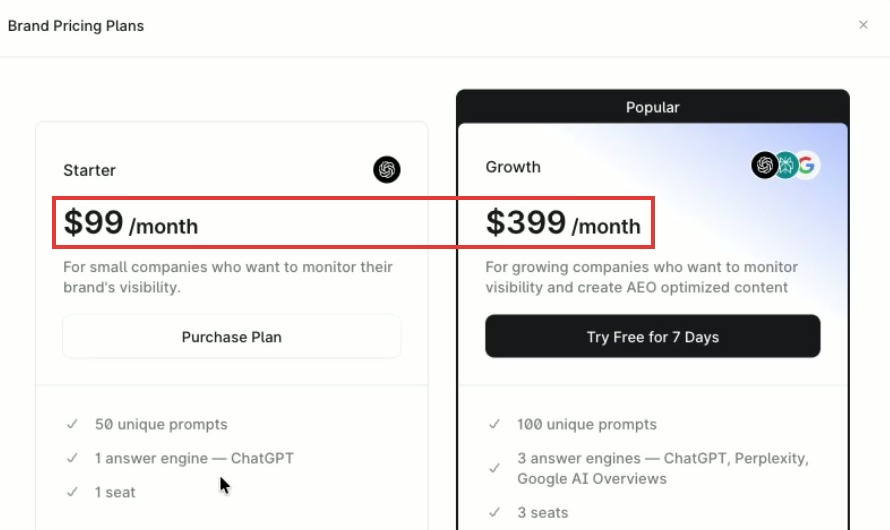
Note: I saw these prices inside Profound's app in October 2026. Check them before you buy.
Onboarding: 4 tries to get in
Getting into the trial took me four sign-ups.
I said I was an agency. Profound sent me straight to a $99 checkout. My only options were to pay or to log out.
I tried my personal Gmail address. Profound refused it.
I signed up with another business domain. Profound analyzed only that domain, so the account showed only that other site.
My FatGrid work email worked. I got the trial with 100 AI Marketer credits.
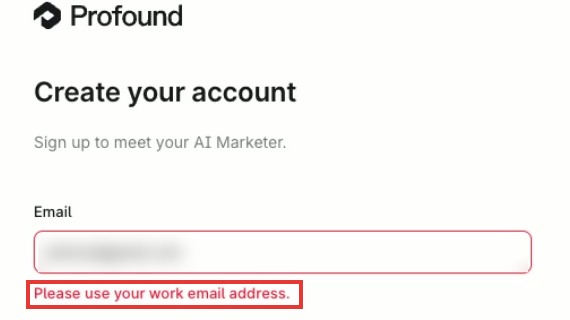
As a reviewer, I was annoyed. As a founder, I get it.
Profound filters its leads hard: work email only, the trial locked to your email's domain, and agencies pay from day one. That keeps out data scrapers and free riders.
Then there's the interface. I felt lost more than once, and the main screen showed empty charts on day one. Most of the product lives in the AI Marketer chat.
What other users say
On Gartner Peer Insights, Profound scores 4.7 out of 5 from 26 ratings, all of them 4 or 5 stars. I read it on October 30, 2026.
Reddit is cooler. A thread in r/SEO_for_AI calls Profound's push to write your content "a terrible idea".
My take sits in between. Profound's analysis is smart. Its advice, on my brand, was generic.
Profound alternatives
If you need something lighter, these are the trackers I'd look at next:
Peec AI: from $95 a month for 50 prompts on 3 AI models. It answered three of my six questions. (Read my hands-on Peec AI test.)
Otterly.AI: from $29 a month for 15 prompts, with a free trial.
Scrunch: from $250 a month for 125 prompts on 4 AI models, with site audits included.
AthenaHQ: a free plan with $25 of credits. Paid plans start at $295 a month.
I'm putting each of them through the same six questions.
My verdict: who should pay for Profound
Profound is a legit tool with a strong team and a lot of money behind it. On my test, it answered none of my first four questions.
Its AI Marketer is the best part. It read my website correctly and explained its own mistake. But the fix sits behind Enterprise.
It fits you if you're a large brand with an Enterprise budget and time for a setup call with Profound's team.
It's a weak fit if you run a small business or a niche B2B brand and want to try before you talk to sales. I'd have stopped 20 minutes in. I kept going only to write this review.
If you do try it, do one thing first: ask AI Marketer what your business does. If its answer is wrong, your prompts will be wrong too.
Want to see how the others compare? I'm testing the major AI visibility trackers with the same six questions. Tell me which one I should review next.

Max Roslyakov
Founder, Xamsor