SaaSpocalypse: 7 SaaS Tools We Replaced and 19 We Keep
Our real SaaS bill is $45,926 a year. We replaced 7 tools with in-house software and keep 19. Here is what went, what stays, and what really decides which tools go.
Some people say SaaS will not exist in 12 months. They're mostly wrong.
Others say vibe-coded apps fall apart, and their support costs more than the subscriptions they replaced. They're wrong too.
I know because we spend $45,926 a year on SaaS, and we've already replaced 7 of those tools with our own software. 7 more are at risk. And 19 are staying, probably for years.
In this post I'll show you the whole bill, line by line. You'll see what we replaced, how long each one took, and the one rule that decides which tools die and which survive.
First, the one idea that explains all of it.
The key idea: your first replacement is the hardest
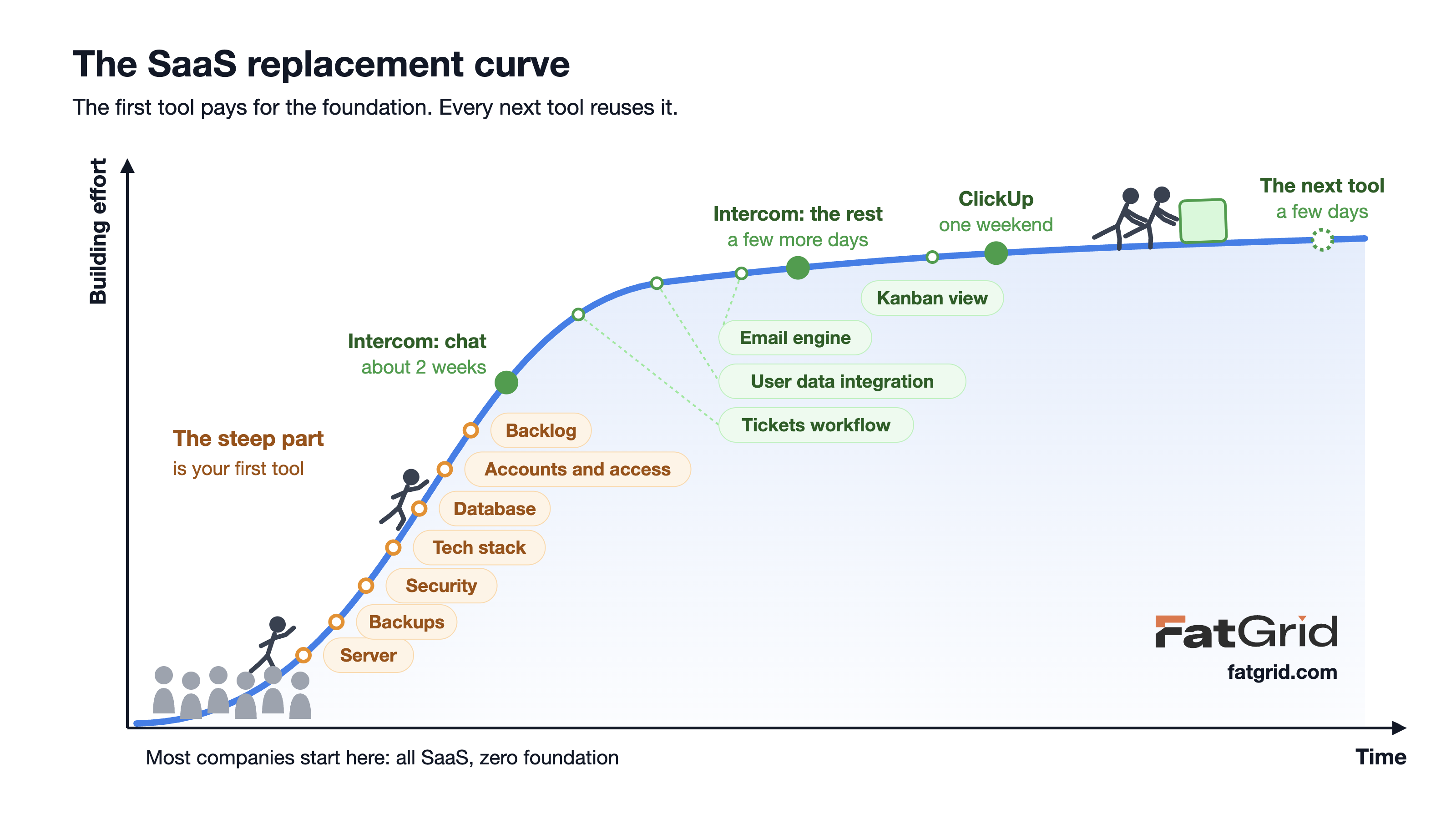
Imagine your company runs only on SaaS. You have zero in-house apps.
Your first replacement is a steep climb. Before you build a single feature, you need answers to a long list of questions:
Where does it run? You need a server or some kind of hosting.
What happens when it breaks? You need backups.
Who can get in? You need a basic security check, accounts and access rules.
What do you build it with? You pick a front end, a back end and a database.
How do you decide what to fix next? You need a backlog and some discipline around it.
Here's the thing most people miss.
Once that foundation exists, every next replacement gets surprisingly easy. You already have the server, the database, the login, the design rules. A new tool is just a few new pieces on top.
Our own timeline shows it. You'll see it tool by tool below, right after the bill.
What is the SaaSpocalypse?
The SaaSpocalypse is the idea that AI coding tools like Claude Code and Codex will let companies build their own software and cancel their SaaS subscriptions. If enough companies do it, a big part of the SaaS industry loses its customers. The debate is about which tools are actually at risk.
Our SaaS bill, line by line
Here's every subscription we paid over the last 12 months, in US dollars. 95% of it is business. A few lines are personal.
Already cancelled: $4,663
Tool | Last 12 months |
|---|---|
Intercom | $1,872 |
Instantly | $1,164 |
QuickBooks | $588 |
Squarespace | $349 |
ClickUp | $336 |
WordPress | $254 |
Monarch Money | $100 |
Total | $4,663 |
At risk: $2,390
Tool | Last 12 months |
|---|---|
GoDaddy | $599 |
Hunter.io | $588 |
Mailjet | $480 |
Slack | $315 |
Fathom | $192 |
CookieYes | $120 |
Loom | $96 |
Total | $2,390 |
Low risk, we keep them: $38,873
Tool | Last 12 months |
|---|---|
Stripe | $7,650 |
Claude | $6,720 |
Semrush | $6,672 |
Hetzner | $4,680 |
Google Workspace | $3,205 |
Ahrefs | $2,988 |
OpenAI | $1,800 |
PayPal | $1,422 |
Google Fi | $1,239 |
Moz | $900 |
GitHub | $370 |
Screaming Frog | $279 |
$222 | |
Wise | $210 |
Grammarly | $144 |
Tailscale | $144 |
AWS | $118 |
Cloudflare | $60 |
Plaid | $50 |
Total | $38,873 |
Look at the split.
The 7 tools we replaced are only 10% of the bill. The tools at risk are another 5%. The other 85% sits in tools we plan to keep.
So if the SaaSpocalypse is real, it starts with the small line items.
The 7 tools we already replaced
Intercom: two weeks for the chat, a few days for the rest
Support was our first system, and we replaced it more than a year ago. The trigger was a sudden $600 charge.
The simple online chat took a couple of weeks. That was the steep part of the curve: server, stack, accounts, all of it.
Turning that chat into a full support system took a few days. The foundation was already there.
And now it does more for us than Intercom did. When a customer writes in, we see their account, their orders, their subscriptions and any errors they hit, in seconds. Support now lives inside our business system.
ClickUp: one weekend
I wanted to see how fast we process orders and requests from our users. The ClickUp API said I needed to upgrade from "Unlimited" (yes, really) to "Business" to see task history older than 7 days.
I paid a few hundred dollars. It still didn't work.
So I asked myself what ClickUp was selling me. My own data, wrapped in an API and some UI?
Our messaging and ticket modules from the Intercom replacement were already solid. We added tasks, projects and a basic Kanban board, and moved our product backlog in. It took me about one weekend, plus a real programmer for the harder parts.
ClickUp is a big, mature product. But when we started, we were maybe 85% ready.
Now I have unlimited history. And I pay less.
Instantly: a weekend for the first version
Instantly's real moat is its warmup pool. We skip it on purpose. We prefer careful segmenting and a slow ramp-up for each mailbox.
The rest is easy to copy if you're on Gmail. We built a wrapper around Gmail, a Postgres database, and a module for queues and sequences. The first version took a weekend.
It grew into the communication heart of several products. It searches across all our mailboxes, attachments included, in milliseconds. It sends cold outreach, everyday work email and transactional email.
I have zero coding background, by the way. Claude Code built all of it.
QuickBooks and Monarch Money: one system for about $4 a month
QuickBooks (business) and Monarch Money (personal) became one in-house app. Plaid connects to the banks. Postgres stores the transactions. A bit of Python sorts them into categories and builds the reports.
I expected Plaid to say no. Claude filled in the application honestly: no security officer, no formal protocols, no certifications. Because the app is internal and used only by us, Plaid approved it in minutes.
It costs about $4 a month.
WordPress and Squarespace
WordPress was one of the first to go. We moved our sites to a self-hosted setup.
Squarespace hosted my personal website until they raised the price. That was the end of it.
The 7 tools at risk (and why they're still here)
"At risk" means we could replace them. Each one still stays, and each for its own reason.
GoDaddy ($599). It's all domains. I could move them to Cloudflare with one Python script and a couple of hours of planned downtime, and save at least 30%. The savings are too small to bother. For now.
Hunter.io ($588). Our own tools now find more than 80% of the contacts we need, and they're always fresh. We use Hunter at about 10% of what we did a few months ago. It's a fallback now.
Mailjet ($480). Sending email at scale takes real work. Dozens of similar services do it well, so switching is easy.
Slack ($315). I'll come back to this one. It's the most interesting case.
Fathom ($192). Transcription can run on Whisper, which is free and works on a cheap NVIDIA card. The rest is a database and a UI. Saving $16 a month is too small for a project. But when Fathom shows up more than 10 minutes late to a team call, that's over $100 of paid time wasted. Bugs only the vendor can fix are a cost too.
CookieYes ($120). A small tool with a simple job.
Loom ($96). We keep it only for some old video guides. It raised prices after Atlassian bought it.
The 19 we keep
These tools are safe, and they include our biggest costs. Stripe, Claude and Semrush are the three biggest lines on the bill.
They fall into a few groups.
Data at web scale. Semrush, Ahrefs and Similarweb spend tens of millions of dollars a year crawling the web and collecting search data. A subscription costs a tiny fraction of that, and the data stays fresh. Here's my test for anyone who says these tools are easy to replace: estimate the total traffic of 100 websites, split by channel and by country, without them. I'll wait.
(We do use DataForSEO for scraping. It's good, and the big data sets are still well ahead of it.)
Data your users expect. Some clients trust Ahrefs numbers and nothing else. A competitor I bought relied fully on Ahrefs, and its users expect that data to be there. Moz data powers a few free tools we use to bring in leads.
Money rails. Stripe, PayPal, Wise and Plaid move or connect money. Moving money takes licenses and bank partners. The code is the easy part.
The foundation itself. Claude, OpenAI, Hetzner, AWS, Cloudflare, GitHub and Tailscale are what our in-house apps are built with and run on. The funny part? The tool that replaces SaaS is SaaS. Claude is our second-biggest line.
Everything else. Google Workspace, Google Fi, LinkedIn, Grammarly, Screaming Frog. Useful and fairly priced, so we keep paying.
The real rule: the cost of leaving decides
Slack shows it best.
I dislike Slack. It's an overpriced chat. We even replaced it once, with ClickUp, and then with our own system.
Then we went back.
Our biggest enterprise clients live on Slack, and a big company keeps its chat app, whatever its vendors prefer. So we follow them, and we pay.
That's the whole rule. The cost of leaving decides if a tool dies. And that cost often sits outside the tool: in your customers, your partners, or data only a giant can collect.
Fathom and Loom are great products. But they're at high risk, because leaving them costs almost nothing.
What the skeptics said (and what actually happened)
My LinkedIn post about this bill got 148 comments. Plenty of them pushed back. Here are the five objections I heard most, in the commenters' own words (names hidden), and what our numbers say.
"You'll drown in maintenance"
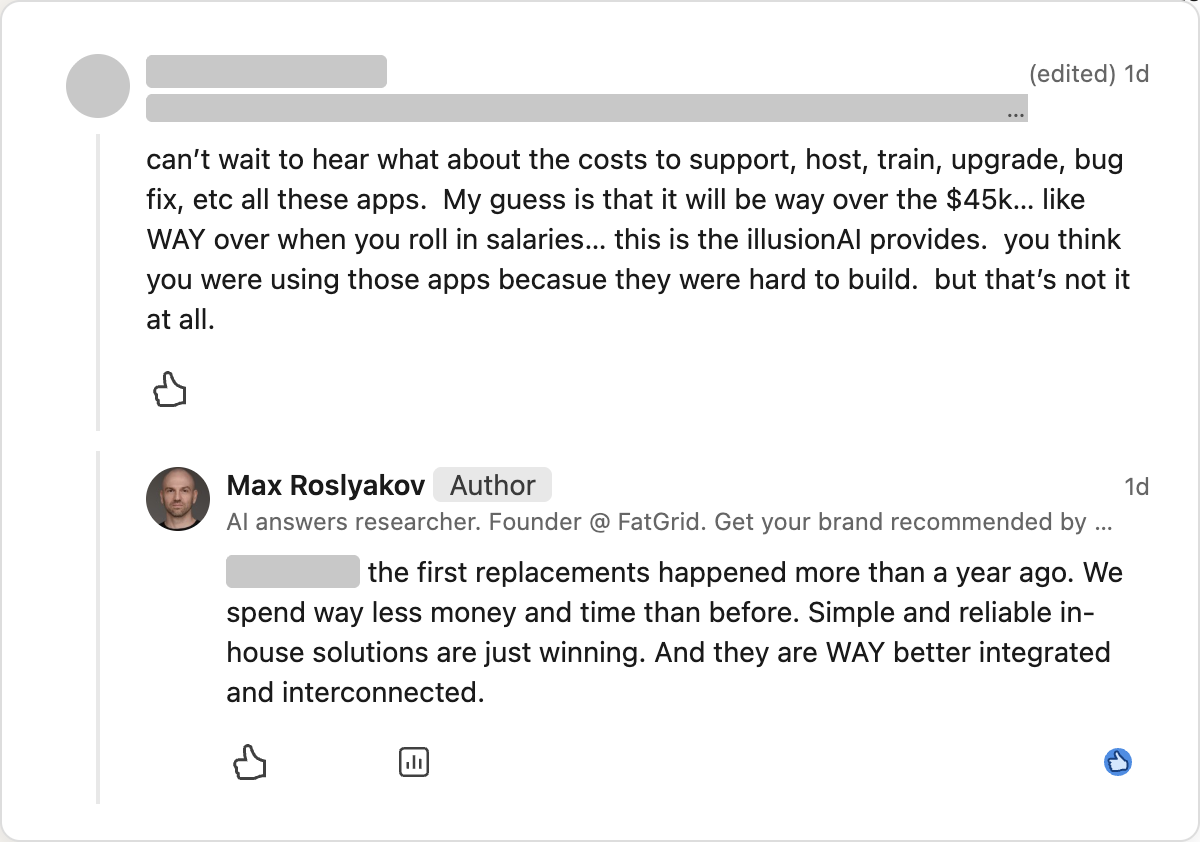
This was the most common reply. It sounds right. Here's what our numbers show.
The first replacements are more than a year old. Our maintenance time on them is close to zero unless we add something new, and Claude does most of that work. We spend less money and less time than before.
"Someone will get hacked"
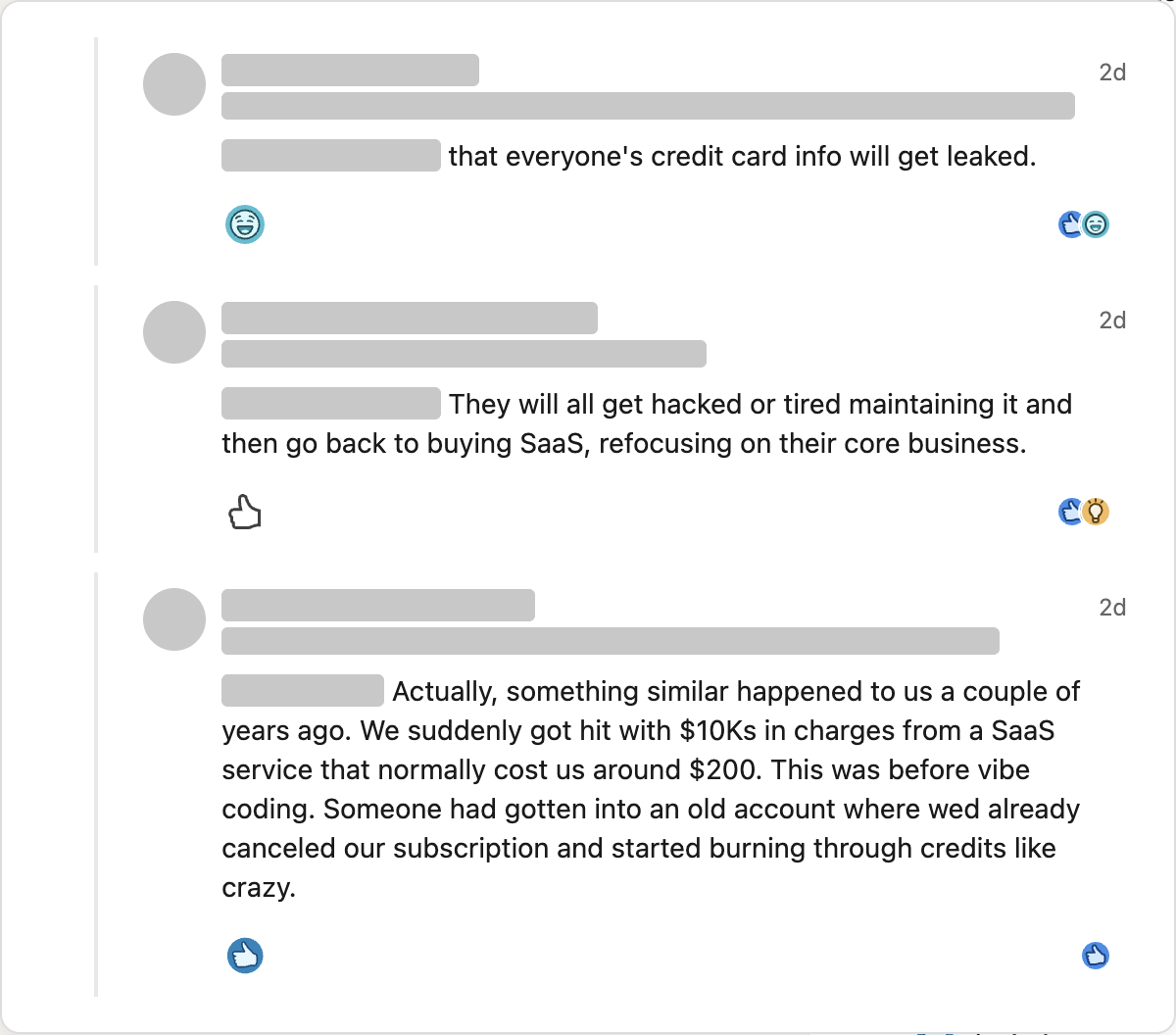
Fair. Security is the one part of the foundation you must get right.
But look at the third reply. That company lost tens of thousands of dollars through a SaaS account they had already cancelled. SaaS carries the same risk.
"Most people can't build this"
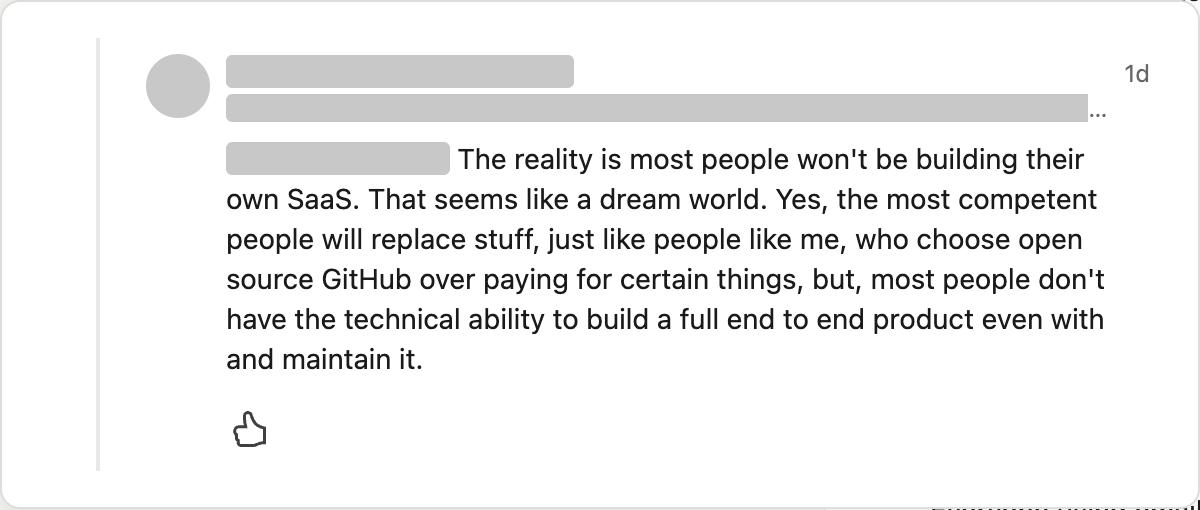
True. I doubt more than 5% of business owners have ever written code or heard of Claude Code. Most will keep buying, the same way people who can cook still order takeout.
But I know founders with zero coding background who now run their business on apps they built. They teach others, and more people will follow them up the curve.
"Some tools are harder than they look"
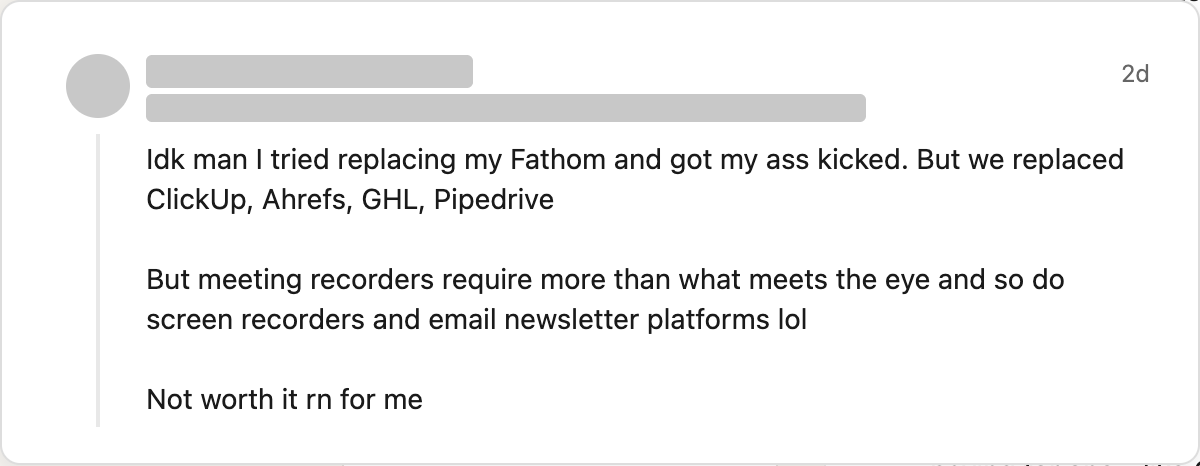
Also true. Meeting recorders, screen recorders and newsletter platforms hide a lot of work under a simple surface. Fathom is still on our bill too. Saving $16 a month is too small to justify that work yet.
"Your safe tools are at risk too"
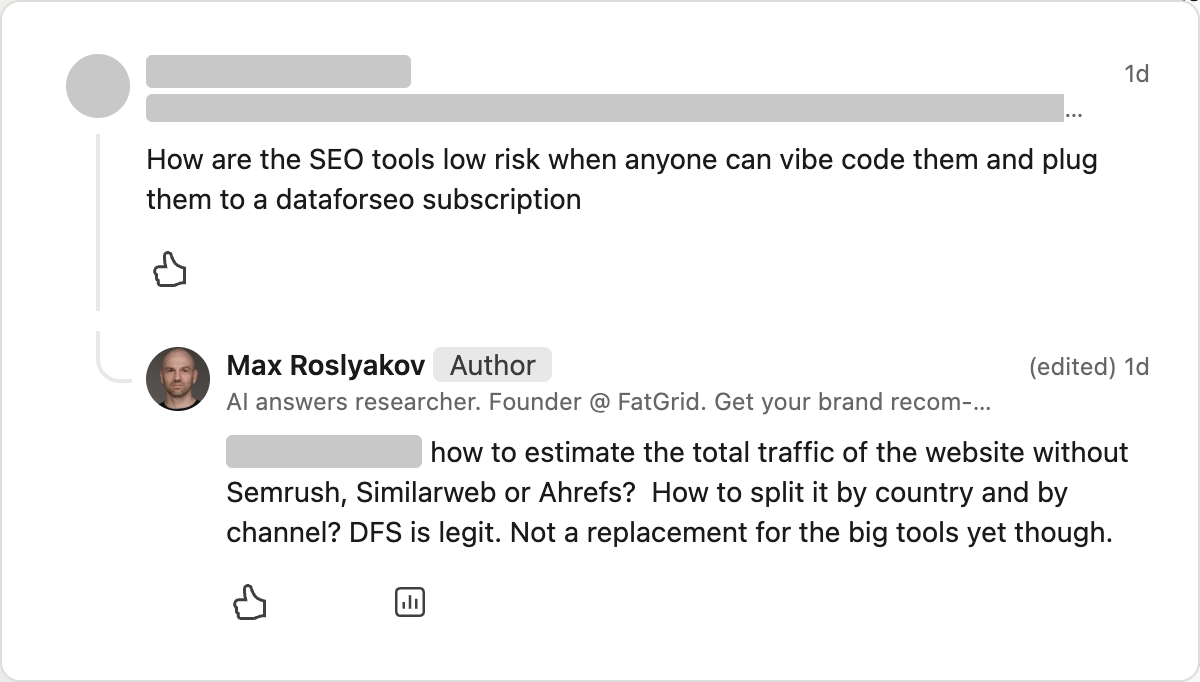
Several people said Semrush, Ahrefs and Moz are easy to rebuild on cheap data feeds. For some jobs, maybe. We use DataForSEO ourselves.
Nobody in the thread answered my question. The data is the product, and it costs tens of millions of dollars a year to collect.
Should you replace your SaaS? A quick test
Pull your card statements for the last 12 months. Put every subscription in one of three columns: cancelled, at risk, keep.
A tool belongs in "at risk" if most of these are true:
It's mostly your own data with a UI on top.
Its only moat is features.
Only your own team uses it.
You already have a server, a database and one in-house app to build on.
It hurts you: a surprise price jump, a paywall on your own data, bugs only the vendor can fix.
Owning it would connect it to the rest of your business.
Keep it if the data is the product, if your customers live in it, if it moves money, or if the savings are too small to matter.
Start with one tool from the "at risk" column. Expect the first one to be slow. The second one goes much faster.
FAQ
What is the SaaSpocalypse?
It's the idea that AI coding tools will let companies build their own software and cancel SaaS subscriptions. In our case it's real but narrow: 7 tools replaced, 10% of our SaaS bill.
Is SaaS dead?
Most of it will stay. 85% of our SaaS spend goes to tools we plan to keep: data providers, payment rails and the AI and cloud services we build on. Simple tools with low switching costs are the ones at risk.
Which SaaS tools are easiest to replace with AI?
Tools that wrap your own data in a UI: chat and support, task management, cold email, bookkeeping. Tools built on huge data sets or networks, like Semrush, Ahrefs, Stripe or Slack, are the hardest.
How much does it cost to maintain in-house replacements?
For us, close to zero time unless we add features, and most of that work is done by Claude. The real cost is the first build, when you set up servers, backups, security and your tech stack.
Do I need to know how to code?
You can start without it. I have zero coding background, and Claude Code built our replacements. For the bigger ones, like ClickUp, a real programmer helped with the harder parts.

Max Roslyakov
Founder, Xamsor